I’d planned this walk for the best part of four years, or at least a portion of it. About a five minute walk from my mum’s house lie fields, fields which cover the north-west portion of the Wirral peninsula, halted only by towns to the north and two winding, blind cornered B-roads to the south.
I’d walked to the fields plenty of times, to play football, walk dogs, or smoke. I’d always spend a portion of my time here focussed on a sandstone ridge to the south-west, and the column on top of it. I knew this column, an old maritime beacon, from travelling past it hundreds of times on my way to secondary school. Looking at maps I felt certain there was a way to get to it by walking directly across the fields on the interior of the peninsular.
During time at home for Christmas, I’d accidentally woken up early in my mum’s single-bed box room and decided to finally do it. I loaded up on some toast, a cup of tea, and a bit of odd tasting chocolate from a mate as fuel; bananas, oatcakes and prawn cocktail Seabrooks for lunch. I set off somewhat-prepared in walking gear at 07.45.
I headed for the fields, thinking about my bed whilst walking along the main road. When I arrived at a narrow, muddy, overgrown footpath that led towards the open fields, walking became a lot easier. After navigating standing water, careful not to fall into the ditch on one side of the path, the ground began to harden and the trees covering above thinned. I was welcomed to a grey-blue dawn sky and coral clouds above and open green fields, and the column beyond them, to my right. I continued along the back of a crop field to a concrete crossroads. Ahead, a farm, to the right, the concrete dissolved to earth and led, eventually I thought, to the column.
Checking the maps on my phone for any sign of a footpath or landmarks, I saw a thin string of blue cutting the direct route in half. I’d seen people walk this way in the past, so I just charged on. There were swells of birds rising and falling on the fields and all I could smell was dew, that settled in the back of my nose. As the day began to brighten, the thin string of blue materialised – the first liquid barrier of the day, swarmed in six foot reeds. I thought about it, but there was no way of jumping, so I continued along the stream as far as I could before another one boxed me in. This stream wasn’t surrounded by reeds, so I backed up ready to jump it. As I took a few steps back, I stopped to admire the quaintness of the stream, the crystal clear water, and the backdrop of the fields, the sandstone ridge, and coral sky. Utter stillness. It would be an idiotic affront to dawn to jump that stream. I decided to turn back.
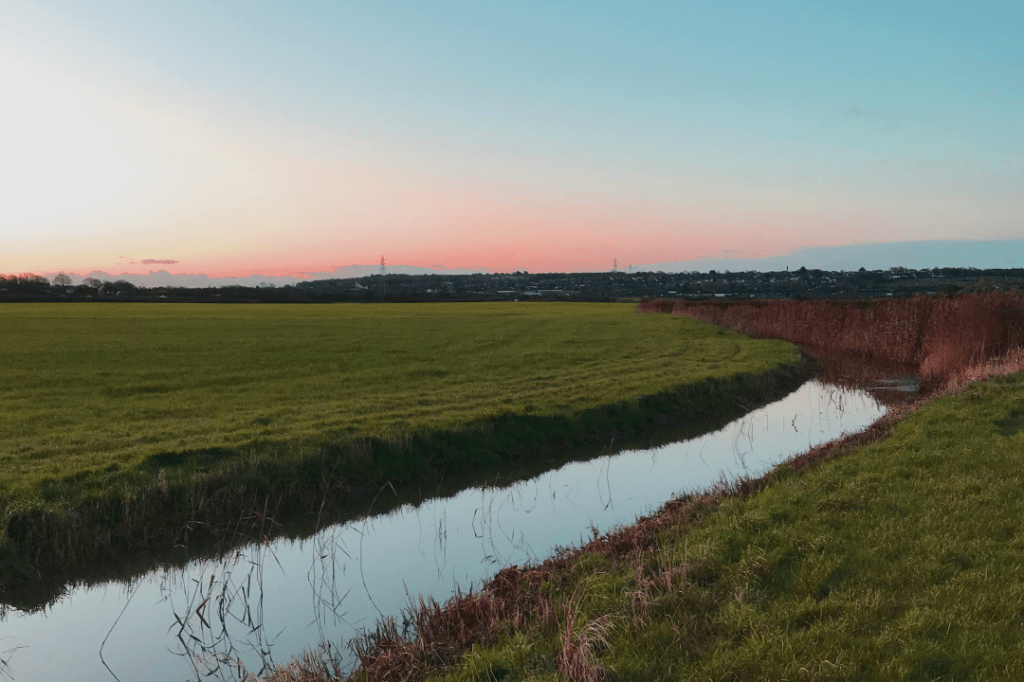
Back at the crossroads I took the road towards the farm, walking parallel to the ridge I was intending to get to. Finally, a footpath sign appeared, pointing towards my destination, and I followed it. A muddy, thin, afterthought of a thing. I was veering towards one of the B-roads that cut the fields in half, but checking directions on my phone offered no alternative. And I was only on 40%, not in the habit of charging my phone overnight anymore. It was this point that the sun finally broke through at 08:30, first illuminating the clouds and allowing the birds in the sky to glimmer like dust caught in the beam of a projector. I’d never seen the fields from this angle before.
Eventually, traffic broke through the hedgerows and I felt that the first chapter of the journey was done. Ending up, somehow, in the driveway of Newton Hall Cottage. I knew this section of road from when I used to drive it, and it scared me then. The opposite side of the road had the wider path, so I crossed the road, only able to use my ears due to the blind corners, hoping that nobody around here owned a Tesla. I managed to cross, and I headed for a road that led to Newton, a familiar town. I was very aware that I was a careless driver of a German car away from becoming a headline.
With the B-road behind me, walking up a slightly less treacherous minor road, I passed horsefields on the right, and a farm and constituent shop selling homemade sausages – which seemed like the kind of shop that would be outwardly surprised at custom – on the left. Wafting from somewhere was the smell of something rotting, but something not altogether unpleasant, which grew stronger. The source was a field full of grazing sheep, and on the ground, turnips. I gazed at the sheep, and some of them gazed back in that watchful, frozen way that sheep do.
Eventually, the sheep scattered, probably having enough of me looking at them with an expression on my face full of slightly anxious wonder, so I headed on past The Ridger pub, looking lonely and needy amongst the government restrictions, and on towards Grange Hill, which led up to the top of the ridge, and the column. I took a right, towards my destination, and passed all of the houses I used to aspire to live in. The new builds, once seeming so desirable, now looked odd, with each four or five bedroom house facing each other in a display of opposition. Each was adorned with its own car, similar to how board members would wear ever more fancy ties, in silent, fabricated competition with each other.
I arrived at the column at 09.15, and there was a welcoming bench. Out came a first banana, and I sat looking over the houses of West Kirby, and across the Dee Estuary, towards Wales. The sun seemed shy, popping out of the clouds every so often, but when it did, it shone on the archipelago of the Hilbre Islands and made them appear resplendent. My plan was to make my way down from the ridge, through Caldy common, and make my way back home along the coast.
Following that smell of sandstone, emanating from the ground of the common, I took a path I’d taken on many compulsary cross-country running sessions. Coming my way were hobbyist runners, first three, then two, and eventually a slower one, the procession reminding me of fleeing gazelle. I headed the way they came, through familiar scratching gorse and the intensifying, heady smell of sandstone. The enclosed, winding common allowed for introspection, with the occasional sense of wonder when getting to a clearing and seeing the distant Dee. I wandered past dog walkers, each of them seeming like a part of nature, until a distant internal compass took over and took me to a well-trodden path, along a mini-arete, and down, along the back of houses, onto the road.
To the left, was an old friend’s house, and to the right, I would eventually get to the marine lake and promenade. I decided that I would walk along the lake and continue along the coast to arrive home. Passing smiling, nodding walkers, people in distanced doorstep conversations, families forming into single file, I saw the marine lake ahead of me and fixed myself on it. Tourists took pictures, cars parked, and civilisation seemed to stir.
Walking along the lake I noticed people walking on the beach, and almost without thinking, I left the tarmac and mirrored them. The second I set foot on the beach I looked over my shoulder, and up the Dee Estuary. The clouds were big, with sun-beams escaping them further up the estuary. I kept looking back at this massive wall of light, with Wales basking to the right. The ground was patterned sand with occasional clear pools of water. I kept walking, and could see the smallest island of the archipelago, Little Eye, getting closer, and people walking towards it. I decided to take a detour before going home. I would walk out to the islands.
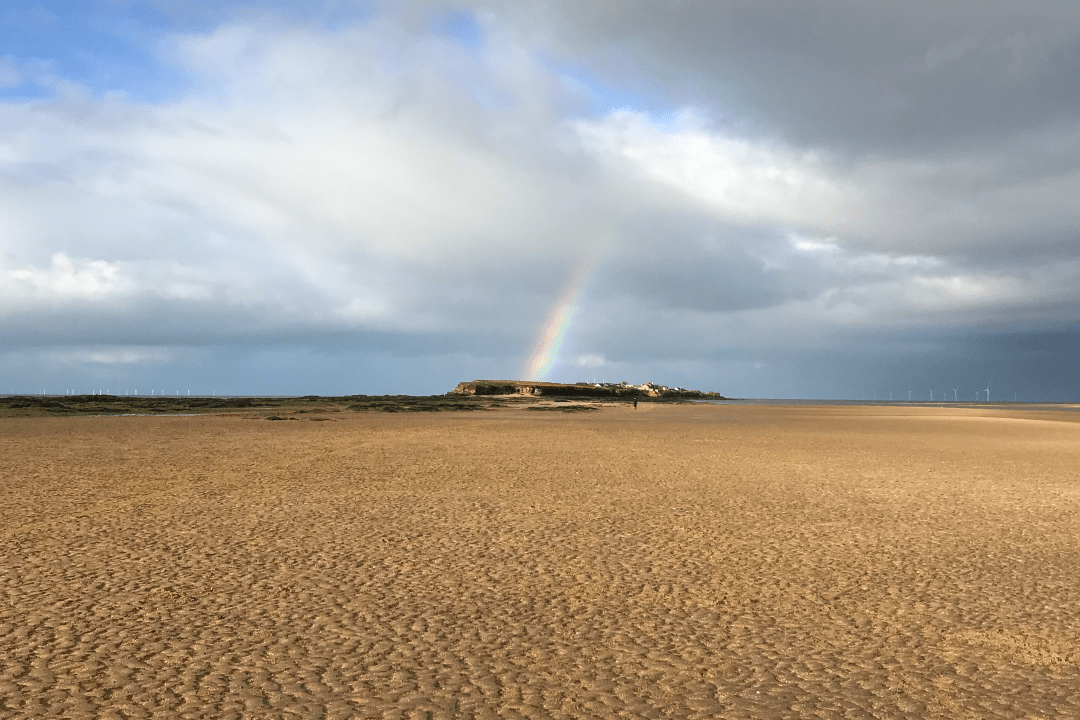
The first sandstone outcrop is nothing more than a stop-gap, a point in the safest route over to the main two islands. Nothing but a weathered and unidentifiable World War Two air raid defence. Onwards to Middle Eye, across the rocky seabed, dressed in blue mussels and seaweed. The air was damp, and ahead I saw a rainbow, landing on the beach on Middle Eye. I needed to stop and take a moment for this, and gaze back up the estuary. In any map you see, I would be standing in the middle of the ocean.

I landed at the beach on Middle Eye, a sea-formed arch leading to a shielded nook. Out here, the tide was close. To the left, as it always is, a barrier between Wirral and Wales, and now creeping to the right, threatening a barrier between the islands and home. There were other people ahead of me, and behind, so I continued, over the soft-grassed Middle to the main island.
The striations on the sandstone at Hilbre caught me. Just how long had this place been here, formed from the compacting of the sand, itself made up from eroded rock? Land formed from recycled land. A concrete slipway drew me to the surface of the outcrop. Passing the cottages on the right, I felt it a shame that nobody still lived here. Why wouldn’t they? No gas, electricity or running water is surely a small price to pay for living here. I stopped next to a stumped brick pillar on a small hill and looked back at the route I took. Two people passed to my right, heading on the one path back off the island. I wondered where they had come from, so I continued on.
I reached a small ruin of a building, with a landing ramp heading out to sea at the very tip of the island. There was no roof, but remaining on one wall was a sandstone fireplace. Every brick would have to have been brought from the mainland, much like the cottages. The tide seemed to have crawled up the landing ramp, and I decided to head back. I walked a bit faster than usual, stories my Gran had told me about people being claimed by the tide crashing around my brain.
I left Hilbre Island, and walked across the hard bedrock to Middle Eye. I could hear the tide now, and looking to my left I could see it rushing over the rock into a pool. I started to jog. It was a fair climb back up to Middle Eye, and once on top I could see a group of people on the seabed between me and Little Eye running and jumping over incoming water. I ran across the top of the island and down to the beach and the slippery rock. Looking ahead the group were shin-deep in a pool of water, with their path ahead clear. If I ran I could make it, but I could also slip. After a moment of hesitation, I resigned to being stranded and turned back.
Arriving back on the beach, I checked the tide times. It was two hours until high tide at 14:08. I reasoned that I would have to wait until two hours after high tide before returning. Four hours it was then, stranded on a tidal island. I headed through the archway and put my bag down in the alcove. 20% battery. I called my mum to let her know I’d be home a bit later than expected, and explained why. “You are your father’s son”, she said, “He always wanted us to just go off to Hilbre Island. I’d remind him of the tide times, but he always said ‘it’ll be fine!’”
I watched the tide come in from the beach, using rocks as reference points. It slowly but firmly closed off all routes back, and brought with it a weather front and rain. All thoughts aside from ‘keep dry’, ‘save food’ and ‘stay alive’ vanished, which was strangely liberating; all thoughts I carried back from London gone, no more endless worrying about doing every, little, pointless, thing.
From the alcove on the east of the island, everything was peaceful, nothing but the primal, stupefying sound of water lapping. But once high tide came I headed on top of the island to see another story on the west. Sea battered the rocks, oystercatchers stood firm on the low-grounds of Hilbre, occasionally taking flight and returning to their perch. Nothing but the sound of wind and water.
High tide passed, and the weather abated. Standing on the calm beach I looked north, through two stone outcrops. In the middle of these, I saw the Irish sea and another rainbow landing right in the middle, looking like a desktop wallpaper that seems altogether too beautiful to be real. I followed the rainbow’s trajectory and saw another, the two rainbows splitting the sky in two. Dark blueish sky in the foreground and white overcast skies beyond them.

I took sound recordings, and did a small tour of the island with my camcorder to pass the time. I intended to do more, but I was too struck by the beauty of the situation to really do anything justice. I could do little more than observe and think. One hour after high tide, oystercatchers took to the water between Middle and Little Eye, ready to inspect the seabed for stranded molluscs. Rocks once buried under water began showing their face, and the sun took its position between the clouds and Clwydian Hills over in Wales, adding drama to the clouds. Change was coming to the coast once more, but it was getting dark.

4pm came and went, pools of water remained between me and the route back, but I could see rock. It would take 20 minutes to get to the checkpoint of the smallest island, and in the same time it would be dark. My phone, now on 2%, couldn’t be relied on to light up the way, so I made a break for it. It was getting harder and harder to make out the way to the next island, but right in front of me were exposed rocks offering a route over the pools. To the right, the rushing white noise of the tide continued, to the left, the beacon of the Morrisons. I reached a stretch of water with no rocks for help. I could reach the other side by sticking one foot in the middle and jumping, but the sound of the tide gave me doubts.
The growing cold and dark spurred me on, and I sacrificed one dry foot to reach the other side of the ditch, only to be faced with the same situation. The last remaining dry foot was used to finally reach the higher land leading to the smallest island, where I fixed my eyes on the Morrisons sign, which was reflected in the water that still lay between me and dry land.
I headed towards land as it started raining, but once again reached a barrier of water that cut me off from my intended path. I started to go around it, seeing a faint dry path to the left, lit only by the light coming from land. As I started walking, I could see a light moving from the beach on Middle Eye, where I was standing only half an hour ago. I took my phone out, 1%, and shone a light towards the island, using my hand to create a flash to grab whoever’s attention, and took shelter underneath the brick outcrop on the island.
20 minutes later, the light was close, but I still couldn’t see who was holding it. The light then disappeared and for a moment I thought I was going to be killed, as anyone would, until I walked to the top of the sandstone and saw the man on the other side. A friendly, very scouse voice called out and I reasoned I was safe. I immediately asked for help to get to shore and armed with his powerful torch, we made strides.
The man was a caretaker called Andrew. He explained to me that he often takes himself off to Hilbre for high tide to close himself off from the rest of the world. “It’s good for the soul,” he says, and has once stayed overnight armed only with a bivvy bag. The first time he got stranded was on Middle Eye, and now takes a trip every month or so. Less in the winter, but he needed to get one in before Christmas. We got to shore, I took his number, and parted ways. Him, on the train back to Liverpool and me, walking along the curving Birkenhead Road back home, via the chippy. Half chips, half rice, battered sausage, curry sauce and mushy peas.
I’ve only ever heard of people getting stranded on Hilbre Islands and having to call the coastguard to be rescued. I always thought that people should just wait it out if they were stupid to get themselves into that mess. I’ve never heard of people making their way out there to be stranded intentionally. Reading up afterwards on the history of the islands, it was once a site of pilgrimage for monks, and viking and roman artefacts have been discovered there. How many other Andrews are out there, braving the elements to cut yourself off from the world a mile or so off the coast on a sandstone outcrop, and how many have there been in the past? I’ll certainly be doing it in the future whenever I return from London, and perhaps the whole route I took will become my own pilgrimage.
 George Powell